Author's Note: What started as a concerning week is looking like a year long (or longer) journey of discovery,research, and inner conflict. This will be at least the first post in a series where I argue with myself about John Hattie's Visible Learning Research as it contrasts with my beliefs and the work of Seymour Papert.
Monday was one of the most stressful days to prepare for since I started in De Pere. That's right - more stressful than TEDx, preparing for board presentations, or teaching lessons in classrooms. Why?
Education is an incredibly complex machine. Research can be used to support or decry just about any strategy or methodology. Currently, as a district, we put a lot of stock in Fisher and Frey (The Gradual Release of Responsibility model) and John Hattie (Visible Learning). This research puts the focus on particular structures that classrooms must have in place, as well as an emphasis on collaborative learning and common assessments. To be clear, NONE of those things are inherently bad, or even bad at all.
Now, as a disclaimer, let me just say that I love my district. We have committed professionals trying to make education as awesome as possible for our students. That isn't the point of this blog post.
In past few years I have been enlightened by Maker Education, and more recently, the writings of Seymour Papert. I know that taking stock in simply one person's thinking is often dangerous. We want our students to back up their thinking with a variety of supports, and I think the same. After all, Papert, although highly regarded at MIT, Harvard, and any serious academic circle, doesn't receive ANY time of day at all in undergrad or schools. Hattie, on the other hand, has over 800 different studies that he has analyzed about what works in education. He also believes that the education system as a whole is doing well.
Here is where I'm concerned about overthinking it. Based on my interpretations of Hattie's work, a lot of the areas I believe strongly in and champion do NOT make an impact on student learning. Problem/project based learning, personalized learning, creativity, inquiry, team teaching, and worst of all, student control of learning. In fact, according to his research, student control of learning barely results in any achievement at all.
So here is where I am stuck, and concerned. Are the methodologies and beliefs that I consider to be paramount to education actually not going to help them become successful adults? Is the dream of self-directed learning a recipe for disaster? I want so badly to believe in Papert's work and that if we can just get his vision "right", then we can unleash incredible learning opportunities for our students. The biggest reason I still support Papert over Hattie is because what do Hattie's numbers boil down to? Achievement on standardized tests. That means so little to mean. But it means a lot more to public schools.
And yes, I said Papert over Hattie because I don't believe the two can coincide. It is almost like two paths diverging in the woods. In one route, you head down the Hattie way, and work on good things that make education as it exists better. The other route is far riskier. If we truly embrace the work of Papert and those that aim to foster constructionism, school is completely different. Students will not learn the things they've always learned. They will take wildly different paths. It is quite unlikely that any school that goes this way would perform as well as tests as they would the other path.
Ultimately, I believe that the Papert path can lead to great motivation and engagement in learning for the student. I believe it can improve the school experience for the student in an authentic way. I believe that it can result in incredibly well-adjusted adults because they grew up as children with opportunities to practice with decisions and control.
Some would say that I'm just the "tech guy" and that I shouldn't be overthinking these things. I should just do my job and work to support our teachers. However, as a "tech guy", I believe in Papert's work and that we should be using technology to let our students be creative and discover learning in their own personal way. That is the most effective use of technology there is.
Unless, of course, I'm wrong. And that is what I'm afraid of.
Wednesday, August 31, 2016

Wednesday, June 1, 2016
So Yeah, We Just Hosted a TEDx Event With Middle School Speakers...
The feeling in the room was tense. Months of planning and work coming down to this moment. As she takes the stage, Jolie is unaware of how awesome this day is about to be. The first sentence from a speaker could not have set the tone more perfectly: "Ladies - have you ever been told you couldn't do something because you are a girl?" With that, we were off and running.

TEDxDePereMiddleSchool was a TEDxYouth event planned by a large group of staff at De Pere Middle School. I happened to come up with the crazy idea, so people looked to me as the "leader". In any case, the challenge could not have been any greater: starting in mid March, we had two months to procure 20 excellent student presenters, 5 community speakers, a venue, sponsors, and combine that all together to generate day long celebration of individuality, based upon the theme of "My Unique Contribution to the World". I wrote at length about our planning process in a previous post.
We had a few challenges to overcome to make this happen. First, we needed the venue. Thanks to our lovely sign, and the donation of two big screen TVs by local company Camera Corner, our venue was pretty much set. We had three iPad tripods and utilized the RecoLive Multicam app ($5 on the app store per device) to create some groovy multiple camera angles. For our live stream, we simply had a laptop near the front of the stage that ran on Youtube through Open Broadcast Software. From there, the fanned our chairs in rows. We had 96 seats in total. Our awesome secretaries and head custodian helped block out our 27 windows so the room could be dark like a theater.
Next, we needed volunteers. We had some student greeters, a student social media person, some student camera people, and student MCs. I have to say that if you are going to do this, get students as involved as possible! We didn't have an opportunity to really work with these students on how exactly the process was going to go until the very last week. Guess what happened? They so totally rocked! Check out our Facebook page from that day. Every single post was done by the Amazing Alyssa. She doesn't even have her own Facebook account!


We had a few challenges to overcome to make this happen. First, we needed the venue. Thanks to our lovely sign, and the donation of two big screen TVs by local company Camera Corner, our venue was pretty much set. We had three iPad tripods and utilized the RecoLive Multicam app ($5 on the app store per device) to create some groovy multiple camera angles. For our live stream, we simply had a laptop near the front of the stage that ran on Youtube through Open Broadcast Software. From there, the fanned our chairs in rows. We had 96 seats in total. Our awesome secretaries and head custodian helped block out our 27 windows so the room could be dark like a theater.
Next, we needed volunteers. We had some student greeters, a student social media person, some student camera people, and student MCs. I have to say that if you are going to do this, get students as involved as possible! We didn't have an opportunity to really work with these students on how exactly the process was going to go until the very last week. Guess what happened? They so totally rocked! Check out our Facebook page from that day. Every single post was done by the Amazing Alyssa. She doesn't even have her own Facebook account!
 |
| Our Super Incredible Volunteers |
My Library Media Specialist compadre Donna Young was sensational in helping plan the event and running it. She was in charge of presenter flow. We had to organize 36 humans, 28 of which were students, through the process. We did have a dress rehearsal on the Tuesday prior, so that helped. However, Donna was simply steady as a rock on the day of our event. I could not have done this without her. Another honorable mention was to Melissa Flucke, who helped build our schedule, procure some community presenters, reach our for sponsorship, and got use media coverage with a local TV station!
We utilized our Food Service to feed us during our three breaks and lunch. I felt that the breaks ended up being a little long by about 15 minutes. The day as a whole could have been condensed by about one or two hours, even with the amount of talks we had. However, it was nice to have downtime between each group of speakers.
Being well planned has it's benefits. Because most things were taken care of, I was free to solve tech issues. We had one right off the bat. The microphone for our live feed was not working. While our first speaker was firing away, I was just a few feet in front of her frantically trying to solve the problem, which we did. Jolie's talk was very good, and unfortunately because of this, only the people there got to bear witness to it. Thankfully, the iPads recorded everything so it will be up on Youtube soon! In addition to that little snafu, we also had to quickly generate a new live stream after lunch. Ours must have timed out, so just minutes before our first after lunch speaker, I had to fight with the keyboard to make it happen. Then, while he was rolling, I was updating the links in a million different places. Ahh. I got quite the workout.
I can't say enough about our speakers. They made this event possible. They made this event awesome. Having the opportunity to work with so many students made my entire year. As a tech integrator, I have very few students I get to work with and know. This was such a cool opportunity to work with students over weeks to build towards something and improve skills. It was a proud moment to see them stand a deliver on their passions. Our community speakers also brought some great perspective, cool ideas, inspiring stories, and of course, the feels. There was a lot of heart and a lot of emotion. Everyone was giving their all. Everyone was sharing their unique contribution to the world with the world.

All in all, this was the most incredible experience I have ever been a part of. The amount of camaraderie that was developed between me and my colleagues could not be created out of thin air. All of us working towards the same cause, a clear cause, did wonders for our relationships. I feel like I got to know everyone so much better.
Of course, the event doesn't end when the event ends. Each individual talk needs to be edited out and uploaded to the TEDx Youtube Page. This is where the videos will be housed forever. I am currently in that process now. Using the MultiCam app made my life a lot easier. However, because we didn't really have the infrastructure to support a sound system, the volume isn't ideal. Hopefully we can improve this if we do it again in the future.
If you are looking to do this yourself, understand that the sooner you can start the process, the better. Have a large team, and especially make sure you have enough adults and volunteers to cover everything. Who is welcoming people? Are students introducing the speakers? Who is taking pictures? Who is recording the official video? Who solves the technical problems? Who organizers the presenters? Is there a green room for presenters? How will your breaks go? Will you run all day? The evening? A weekend?
If you are reading this and want to try this yourself, feel free to reach out. I would love to help you in the process as much as I was helped when we were getting started. We didn't do everything right, but we had a unique venue and a totally authentic experience. It also underscored something very important - when students can have a choice in what they talk about and have it rooted in something they are passionate about, they can exceed expectations. These students most certainly did.
Will there be a TEDxDePereMiddleSchool in 2017? Time will tell... :)
Tuesday, April 26, 2016
The Journey of TEDxDePereMiddleSchool...So Far!
At the end of last school year a colleague of mine, the great and wonderful Adrianne Burns, began doing Genius Hour with one of her math classes. She had mentioned how she thought it would significantly upgrade their effort on presenting if we were to do a TEDx conference for them to showcase their projects. Thus, the idea was planted. After some conversations with my unofficial TEDx mentor, Jimmy Juliano about his involvement in the very successful TEDxLFHS, the idea was born. We would be doing a TEDx at my middle school if I had my way!


I began the year with seven distinct goals in mind. One of these was creating a TEDx event. As the year progressed, however, it seemed to drift further and further away. Other initiatives (otherwise known as my day job) pushed the idea of a TEDx aside. It seemed too big to accomplish myself, yet I was wary of bringing in other teachers and putting more on their plate. As February drew to a close, TEDx was about to go out the window.
But at that point, I decided to call a meeting of the dedicated (or crazy) educators who wanted to follow this vision with me. We discussed everything - our shortened timeline, expectations for the event, and how we would procure student speakers. Out of that lunch meeting the TEDx process starting rolling, and hasn't stopped yet.
We introduced the idea of TEDx to our students just before our Spring break at the end of March, and they had three weeks to put together a short application that included a general topic idea and a short video to display their speaking ability and why they wanted to give a TEDx Talk. Our theme is "My Unique Contribution to the World". If anything, it is a celebration of individuality for the 20 students who have been selected. During this time, we also began reaching out to members of the local community to fill five potential slots we had in mind for them. As of writing, we are at four and still searching for one more inspiring member to share their idea worth spreading!
The interest from students surpassed our expectations! Even with the short time frame, we had 27 different submissions. Because some students proposed in pairs, that means nearly 40 students were involved in the process. As mentioned above. we were limited to accepting 20 students due to time and schedule constraints, and we had to make some tough cuts.
So here we are. We have students. We have community members. We have one month. May 27th is fast approaching and we have a lot of work left to do. After all, we want this event to be an amazing experience. Very few middle schools have run a TEDx event, but the hope is it will not feel like a middle school event at all.
What's next for our team? Most important, we have to coach and mentor the students to make their talks professional quality and TED worthy. The day of schedule has to be determined, and we need to figure out just how many volunteers we'll need. In addition, we want to feed the people who attend, so that is a task and a half to accomplish. Speaking of attendees, we can only have 100. Promoting this event to get to that number will be important, but designing an event that keeps them there for an entire Friday will be another task entirely!
Our social media pages and website continue to need work. I am fairly comfortable with my tech skills, but trying to build those out hasn't been easy and I am still not happy with their look.
We have a sign in the works. Our tech ed teacher built a small stage. To show how big this is getting, we even have our secretaries getting involved to make curtains to cover the 27 windows in our library media center so we can get as close to a theater setting as possible.
We have nearly 20 staff members involved in planning this event, with a potential addition of 5-10 student volunteers.
And best of all, any purchases right now are currently being funded by the Bank of Josh. My principal is working hard on funding and partnerships, but we're limited on just how much we can do if we don't find another source besides my wallet. However, I am committed to making this event as awesome as possible and I will continue to do what it takes to make it happen.
In the end, it really comes down to giving our students an opportunity to share their voices, their passions, and themselves with the world. We might only have 100 people in the room, but the event will be live streamed and recorded forever. This is something they can look back on and be proud of. They can use this as they apply for competitive organizations, colleges, and careers. This event is a way to showing students that we want to provide them opportunities that transcend academics but incorporate all of those skills they are learning in their classes.
TEDxDePereMiddleSchool is going to be amazing. With amazing student involvement and amazing staff involvement, it can't help but be that. Hopefully you'll get a chance to join in, whether physically or virtually. And maybe, just maybe, you'll be crazy enough to try and make this happen where you are.
Saturday, March 12, 2016
Adventures in Personalizing Professional Development, Act 1
Whew...what a month!
In fact, to give you an idea of how crazy February was, I haven't gotten around to writing this blog post for nearly two weeks!
Back in December, I attended the TIES conference in Minneapolis, Minnesota. It was incredible. This was where I finally put the pieces together for something I wanted to try, as it related to Professional Development at my school. The catalyst? A great session on gamifying PD by Dr. Anthony VonBank. He spoke on how he tried a "March Madness" tech challenge with his teachers. You can see his wonderful slides here.
This, combined with hearing about the Gurnee district wide Tech Trek, I was equipped to go to the principals in my 5-6 and 7-8 buildings and propose a plan for February. That month was chosen due to a lack of days off, a well-placed late start at the end of the month, and the overall drag February is on everyone's psyche.
As February began, we put together a website, with challenges, teams, points, and prizes. Everyone was in the game, including aides and office staff. You can see our Fired Up for February Challenge here. I had a little fun with graphics and I also built a mail merge using formMule into our submission form so that the staff would get fun messages as a confirmation for their submissions:



In fact, to give you an idea of how crazy February was, I haven't gotten around to writing this blog post for nearly two weeks!
Back in December, I attended the TIES conference in Minneapolis, Minnesota. It was incredible. This was where I finally put the pieces together for something I wanted to try, as it related to Professional Development at my school. The catalyst? A great session on gamifying PD by Dr. Anthony VonBank. He spoke on how he tried a "March Madness" tech challenge with his teachers. You can see his wonderful slides here.
This, combined with hearing about the Gurnee district wide Tech Trek, I was equipped to go to the principals in my 5-6 and 7-8 buildings and propose a plan for February. That month was chosen due to a lack of days off, a well-placed late start at the end of the month, and the overall drag February is on everyone's psyche.
As February began, we put together a website, with challenges, teams, points, and prizes. Everyone was in the game, including aides and office staff. You can see our Fired Up for February Challenge here. I had a little fun with graphics and I also built a mail merge using formMule into our submission form so that the staff would get fun messages as a confirmation for their submissions:
 |
| Philosoraptor is always good for a laugh |
The last piece, which was the biggest part for me, was that if teachers were going to invest their time in this, we needed to provide some rewards. In the future, ideally, we would great a progression or threshold in which all teachers could earn a reward if they surpassed the threshold. We settled on a compromise of top three rewards for individuals and teams at both buildings. Even better - both of our admin included prizes for individuals of "subbing" for that teacher's class. Awesomesauce.
When February launched, I was incredibly nervous. Would people give it a try? Would it make sense? Would this even have an impact? Needless to say, I was floored. Over 70% of the staff involved (nearly 130) contributed something for the challenge. Keep in mind about 5% or less had attended one of our 14 after school sessions offered in the Fall.
Our challenges asked teachers to reflect on their tech usage and look at it through the lens of SAMR (if you aren't familiar with it, you can learn more here). Here was the break down on what people submitted for:

The best part of this entire graph (the point breakouts aren't too surprising) is the large amount (one in every five submission) of leadership points. I wanted to weigh this heavily because I really wanted people to start branching out. Attend edcamps. Participate in Twitter chats. Share with staff. It is safe to say I am more than happy with the amount of teacher leadership I was able to witness. In the end, that can only benefit kids.
In total, there were almost 1000 submissions during the month of February of different things teachers were doing with technology. Since my initial focus was on the tasks being "new" things the teachers were trying, several more that are already integrating a lot didn't submit things they were doing (something to work on the future to make it more equitable). In any case, it was an incredible step forward for our staff.
You can see how I feel about it. But the big question is, how did the staff feel? To find out, I surveyed the staff. 55 responded, giving me a fairly solid statistical significance. Here are some takeaways.
1. This beats regular professional development. People crave choice. Edcamps are awesome and very successful. Twitter could be the best PD out there. Letting people choose what and when they learn is powerful. (For more ideas, I highly recommend purchasing "PersonalizedPD" by the Bretzmann Group):

2. Teachers want to do this again. I believe the collaborative and competitive aspects, combined with the rewards for the efforts of teachers and the way this made our culture fun around technology, made this something that teachers, for the most part, enjoyed:

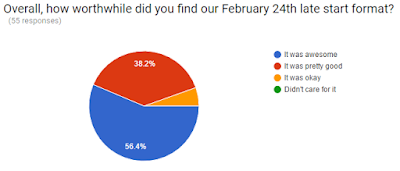
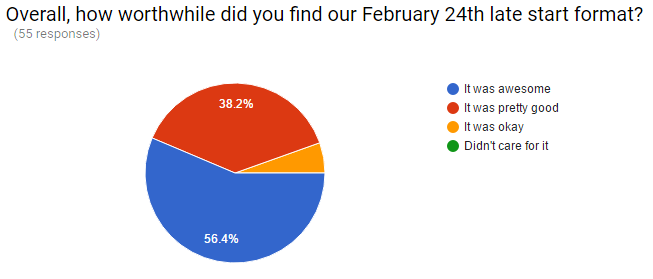
3. Our late start format might be onto something. In late January, I had the privilege of being involved in the first ever Tundra Ed Tech Tool Slam. The premise was simple - 10 presenters would demo a tech tool for 5 minutes. Then, there would be an hour for collaboration and deeper conversations. It was AWESOME. So, I modeled our February 24th late start after this. We were able to combine both of our buildings, and we had 11 teachers/teacher groups willing to share. Then, after that, we did five rounds of "Speed Dating" where teachers could rotate tables and have deeper discussions about the tools and strategies. To sum it up, I hear the same message from many teachers: "I've been in this district a long time. This was the best PD day we've ever had"
4. We don't do enough. We don't provide enough opportunities to learn in a variety of ways. We don't provide enough technology devices. Clearly, this was a positive experience, but several teachers commented that they don't want to commit much to tech integration when they know they can't have devices every day. While I still believe it is important, I can't fault people for feeling that way.
5. Flipped learning is just one piece of the pie. Like with anything personalized, everyone has different likes and interests. Professional development is no different. My favorite part of this graphic, however, is the number of teachers who said they prefer after school sessions. The amount if 11. Only 8 teachers/staff from my two buildings attended one of the 14 after school sessions offered in the fall. I guess I'm not sure what to take from that. Bad timing I suppose.

A lot more feedback is contained on the form. I am reserving the right to craft another post to include a few more graphs and a lot more specific comments from my colleagues.
What we achieved in February could be the start of something incredible. Hopefully, we can expand this so that the other 4 schools in our district can also take part. Perhaps more important, I hope we can make it part of what we do. Instead of being contained to a single month, I'd like to see a longer term "challenge" in which teachers can earn valuable rewards, like a period or two covered. I would also like to build in a progression, so teachers can do down different strands and build skills in a specific category.
If you have any say at all in the professional development in your schools or districts, I truly believe you should try something like that. You can certainly contact me and I'd be willing to help however I can to assist you in implementing this type of PD for your schools.
Thursday, October 29, 2015
Thanks Zaption for Sponsoring #edcampGB 2015!
If you've ever had an opportunity to experience the great professional development that is edcamp, then you need you also thank the multitude of companies that offer their resources and support to make these events happen.
EdcampGB (Green Bay) 2015 was blessed with many sponsorships. One of the great edtech companies supporting us this year is Zaption!
If you aren't familiar with Zaption, they are an online tool that can take videos to the next level by allowing you to add videos, pictures, drawings, and questions that need a response. The videos can be trimmed, and you can import them from a ton of different websites:


www.zaption.com/tours/5632371384ce4c4479d40600
Zaption is simple to use and provides some great options to take videos to the next level. If you are interesting in flipping your class, or you just want to get better formative assessment out of videos you have students watch, Zaption is a must use tool!
EdcampGB (Green Bay) 2015 was blessed with many sponsorships. One of the great edtech companies supporting us this year is Zaption!
If you aren't familiar with Zaption, they are an online tool that can take videos to the next level by allowing you to add videos, pictures, drawings, and questions that need a response. The videos can be trimmed, and you can import them from a ton of different websites:

If you want to add any of the additional features I mentioned above somewhere in the video, you can do so by simply clicking and dragging the icons, and pulling them over the video when it is stopped at the point you want it to be. It will appear on the timeline below the video where it will appear. Certain features, like the response, require an answer before the video will continue:

After you've added all of your wonderful goodies and trimmed your video, you can publish this "tour" for use with the world! One of the publishing options is to share it directly to Google Classroom. Talk about saving time and being efficient!
You can even embed it on websites. My example is below: (NOTE - the embedding feature was causing my blog to jump, so I took it off)
Zaption is simple to use and provides some great options to take videos to the next level. If you are interesting in flipping your class, or you just want to get better formative assessment out of videos you have students watch, Zaption is a must use tool!
Monday, September 21, 2015
Hold Me To It
It has been a crazy start to the year. In the midst of all of this, I've developed seven goals I would like to accomplish this year. All I ask is you help hold me to it.
Here are the goals I've developed. They are a mix of personal and professional goals which aim to improve my school, upgrade the abilities of my colleagues, students, and myself, and improve my well-being:

It is a long year, and it is easy to get dragged down by minutiae That is why, in my mind, it is crucial that I have clear, stated goals. Anything worth accomplishing was never accomplished alone. I'll need all the help I can get, all the support I can get, and all the accountability I can get. By publicly stating my goals, everyone is aware of what I am working towards. This puts the kind of pressure on me that I need!
Reaching all of these goals isn't impossible. They all require slightly different approaches, different timelines, and different levels of support. But, they won't get done if I don't work hard to accomplish them, for my students, my colleague, my school, and myself.
All I ask is that you help hold me to it.
Here are the goals I've developed. They are a mix of personal and professional goals which aim to improve my school, upgrade the abilities of my colleagues, students, and myself, and improve my well-being:

It is a long year, and it is easy to get dragged down by minutiae That is why, in my mind, it is crucial that I have clear, stated goals. Anything worth accomplishing was never accomplished alone. I'll need all the help I can get, all the support I can get, and all the accountability I can get. By publicly stating my goals, everyone is aware of what I am working towards. This puts the kind of pressure on me that I need!
Reaching all of these goals isn't impossible. They all require slightly different approaches, different timelines, and different levels of support. But, they won't get done if I don't work hard to accomplish them, for my students, my colleague, my school, and myself.
All I ask is that you help hold me to it.
Wednesday, August 5, 2015
Oreos, Late Night Runs, and The Importance of Being Driven
Tonight, in a moment of weakness. I ate an Oreo. Then another. In total, I ate 6 Oreos. Now it may not seem like many, but calorie wise, that is a 420 calorie hit at a time when I should be asleep. Now, to many people, that may not be a big deal, but let me provide a short backstory.
Back in January of 2011, while I was student teaching, I suddenly realized, while eating a gigantic bag of Reese's Pieces, that I really needed to stop. I took that moment to weigh myself, and was horrified to see I weighed 242. Only a few years prior to this, I was in the 180s and 190s and totally happy. So, I made a point to restrict my eating. I didn't add a whole lot of exercise, but as I was student teaching, I was up and moving most of the day anyways.
 |
| Nightmare Fuel |
By the following Spring, I had managed to get down to 195. I was excited, happy, and ultimately, in a place that I was okay with. However, if you will notice above, there wasn't really any exercise routine in place, and honestly, getting down to that weight was a "victory" and, after accomplishing that, quit focusing on the things that made the diet successful.
Fast forward a few years to late December, 2014. After eating a big breakfast buffet, my wife and I decided to have Mexican for lunch. Afterwards, I can remember feeling the same explosive feeling in my stomach like I couldn't possibly hold anymore, and that sensation that I had lost all control over my weight.
So I made a commitment to start anew. However, this time it was different. Later that week, I had dinner with my parents, aunt and uncle, sister, brother and sister in law. That night, we hatched a plan to do a family "Biggest Loser" competition. My wife joined in, and soon, we were off to the races. After a week of no pop, cutbacks to eating, I weighed in for the first time at 223.
The competitive side to things always kept me focused, and, in the ultimate geeky move, I actually kept a spreadsheet to track where I could end up if I kept on the same calorie in/calorie out schedule. But, the real turning point came in the form of the weekly challenges we had in our competition. No pop week (I went two months without any). Drink half your body weight in ounces of water per day week. Exercise at least 30 minutes 3 days a week. No fast food. These were key things, because, while I didn't meet every challenge, they forced me to make LIFESTYLE changes, not just eating changes.
Somewhere along the way, I started using a pedometer to track my workouts. As I tinkered with the math on my spreadsheets, I settled on a number of calories burned that would allow me to eat a certain amount but still burn at least a couple pounds a week. This was really the turning point, because now, the obsessive compulsive person in me could not only track what I was eating through looking at plenty of nutrition labels, but now I could track what I was burning.
And thus, for a bulk of the competition, I was looking to get my pedometer to read "1000 calories burned" every day. Thankfully, my job allowed me to keep moving and I did a lot of standing, walking, and walking in place around the house, as well as the Wii Fit. Recently, I even added running to my repertoire and have competed in a couple of races.
So that brings us to now. This morning, after a pretty up and down summer with A LOT of eating, I weighed in at 184. Tonight, I went outside and ran for about 15 minutes. I couldn't come to grips with the fact that I would just eat those Oreos and go to sleep. I empowered myself to take action. It might be too obsessive, but that works for me. Deep inside, my biggest fear is waking up one day, and seeing myself back at those heavy weights again. It drives me to keep thinking about the calories and keep focusing on exercising.
This can be applied to so many things in life. Having a chip on my shoulder about events that have happened in the past is part of what makes me the person and educator I am. Whether it is helping to educate the next generation, helping teachers, being a good husband, or being healthy, it is crucial to always be thinking about what is driving me. What is the point? Because if there isn't a point, then we're all working pretty hard for nothing.
As for me, I know what I am working for, and it is that drive that keeps me going.
So that brings us to now. This morning, after a pretty up and down summer with A LOT of eating, I weighed in at 184. Tonight, I went outside and ran for about 15 minutes. I couldn't come to grips with the fact that I would just eat those Oreos and go to sleep. I empowered myself to take action. It might be too obsessive, but that works for me. Deep inside, my biggest fear is waking up one day, and seeing myself back at those heavy weights again. It drives me to keep thinking about the calories and keep focusing on exercising.
This can be applied to so many things in life. Having a chip on my shoulder about events that have happened in the past is part of what makes me the person and educator I am. Whether it is helping to educate the next generation, helping teachers, being a good husband, or being healthy, it is crucial to always be thinking about what is driving me. What is the point? Because if there isn't a point, then we're all working pretty hard for nothing.
As for me, I know what I am working for, and it is that drive that keeps me going.
Subscribe to:
Posts (Atom)